The video is in Spanish. It has an English audio track in my own voice, generated by an AI model trained on my recordings, and English captions. Both are in the player's settings (⚙).
What NVIDIA showed
On 21 October 2026, at the GTC Berlin keynote, Jensen Huang said that "the way you build an agent is you ask an agent to build it for you". Then NVIDIA showed a demo with the Microduck, a robot about 25 cm tall made by Pollen Robotics, which is now part of Hugging Face.
In the demo, agents do the preparation. Hermes with Nemotron plans an obstacle course, and GPT-6 Astra models the pieces in FreeCAD, textures them in Blender and sets up the scene in Isaac Sim, NVIDIA's robot simulator. Then thousands of Microducks train at the same time in the cloud.
The agents don't teach the robot to walk. It learns by reinforcement learning, which is trial and error with points: every good step earns points, every fall loses them, and over millions of tries a small neural network, the robot's "brain", learns what scores best. What the agents take off your hands is everything around that.
My version, with one agent
I wanted to see how much of this I could do on my own, with what I have at hand. I used one agent, Claude Code with Opus 5.5, in place of NVIDIA's agents, and a GPU rented by the hour on Nebius in place of their new RTX Spark computers. The goal was modest: a simple obstacle course, as a proof of concept.
1. Plan
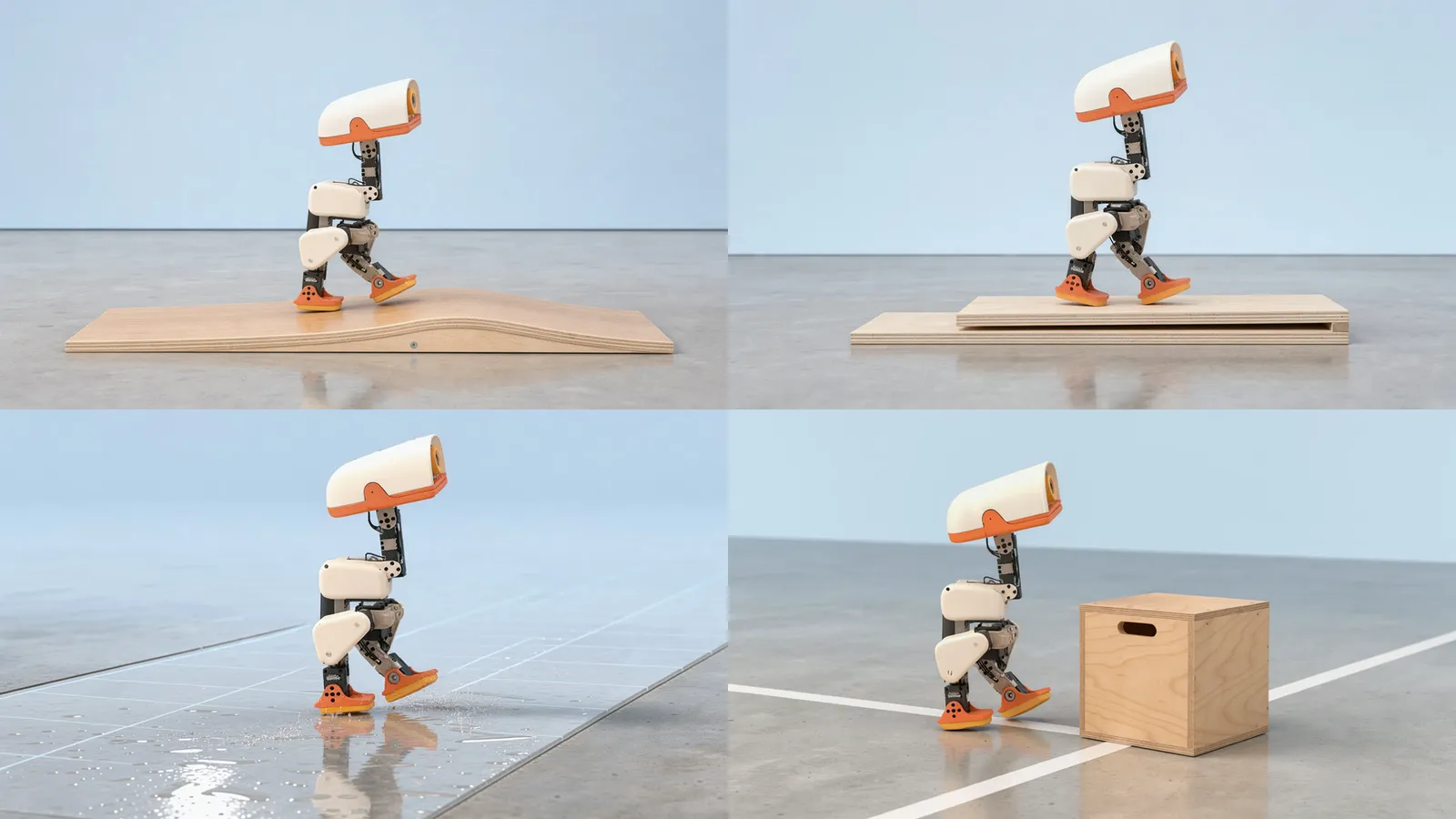
The agent planned four obstacles sized for the robot: a gentle hump, two low steps, a wet floor and a box. It drew each one with FLUX 3, an image model from Black Forest Labs, so I could see what I was asking for before anything was built.
2. Build
I gave it access to FreeCAD and Blender through MCP, a connector that lets an agent use a program the way you would. It modelled each obstacle to size in FreeCAD, textured it in Blender and checked every piece: the right measurements, and a file the simulator can read. Then it put them together into one course with a marked route. I don't know how to use either program, and I didn't need to.
3. Cloud
The agent created the GPU machine on Nebius from the command line, started it, stopped it and worked on it remotely. Every step that cost money waited for my OK. I also asked for a way to see inside the simulation while it ran, and it set up a live stream to my computer.
4. Training
4,096 ducks practised on the course at once in Isaac Lab, NVIDIA's training tool. They didn't start from zero: NVIDIA publishes a brain that already walks, so the training only had to teach it these surfaces, without falling and at the speed it's asked for. That took about an hour.
5. Eyes
The duck has a distance sensor in its head that measures 8 × 8 points on the floor ahead. At first the brain had no use for it. After a second round of training, a little under an hour, with the sensor as an extra input, the ducks learned to walk around the box.
6. Exam
128 ducks on the full course, with three brains: NVIDIA's as it comes, mine trained without the sensor, and mine trained with it.
Two things that went wrong
The ducks got lazy. Partway through training, the ducks were walking at less than half the speed they were asked for. They had worked out that walking slowly still earned most of the points. The network only chases its score, and the score said "walk", not "walk at this speed": in one test, the ducks that finished went from 65 of 128 down to 1. The fix was one extra reward, for moving along the route at the requested speed and no more for going faster. Since the training chart had looked healthy the whole time, from then on every saved version of the brain was also tested on the course while training ran.
The wet floor wasn't slippery. When two surfaces touch, the simulator uses the higher of the two frictions, so a slippery tile under a grippy foot behaved like a dry one. The tile needed priority so that its own friction counts. To check it, the agent turned the tile into ice for one test: 62 of 64 ducks fell.
Results
| Test (128 ducks each) | NVIDIA's brain | Trained, no eyes | Trained, with eyes |
|---|---|---|---|
| The full course | 39 % | 95 % | 98 % |
| Sent straight at the box, nobody steering | 1 % | 2 % | 96 % |
| The box moved to a spot it never saw in training | 0 % | 6 % | 93 % |
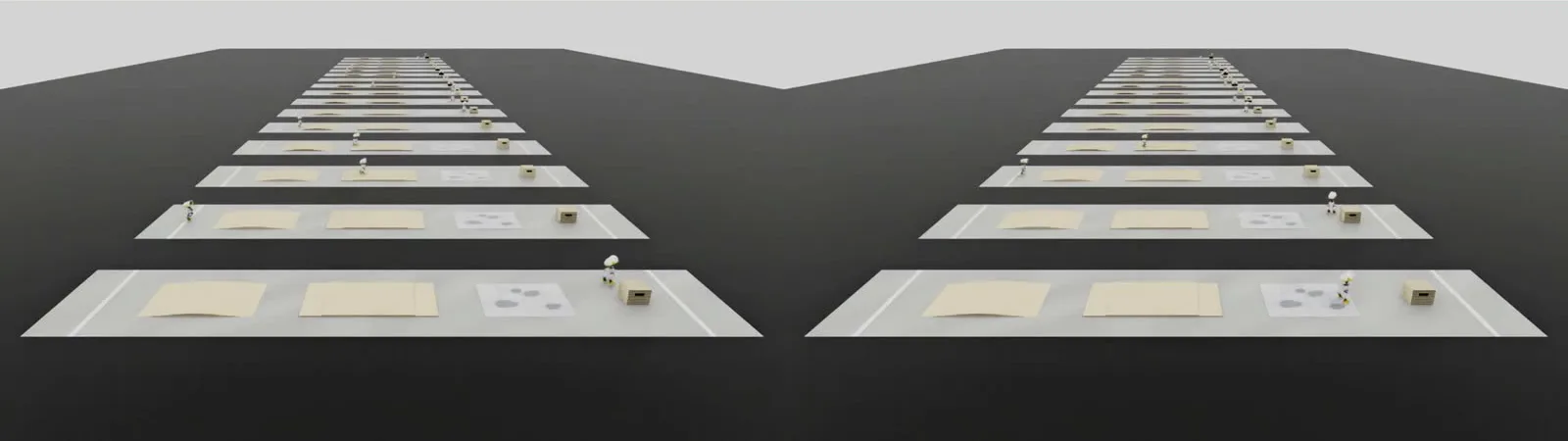
Each test is a single run, so expect a few points of variation if you repeat it.
What it cost
4 hours 50 minutes of GPU time on one RTX PRO 6000, at $1.80 an hour: about $8.71, plus about $0.16 for the disk. The design work ran on my own computer at no cost. Everything, from the first plan to the final exam, was finished on 26 October, five days after the keynote.
Where it is now
It's a simple version: one course, one box, one route, all in simulation. It hasn't run on a real Microduck yet.
What I wanted to show is how fast this is moving. Until recently, setting up the environment to train a robot was work for a team of engineers. Now an agent can design the pieces, build the simulation and run it in the cloud while you guide it.
The code is public on GitHub, with every result, the limits and what each run cost. NVIDIA's own write-up of the workflow is on their technical blog.
This project is independent and not affiliated with NVIDIA, Pollen Robotics or Hugging Face. The keynote quote and the demo are NVIDIA's.